How to Choose a Mobile Evaporative Cooler
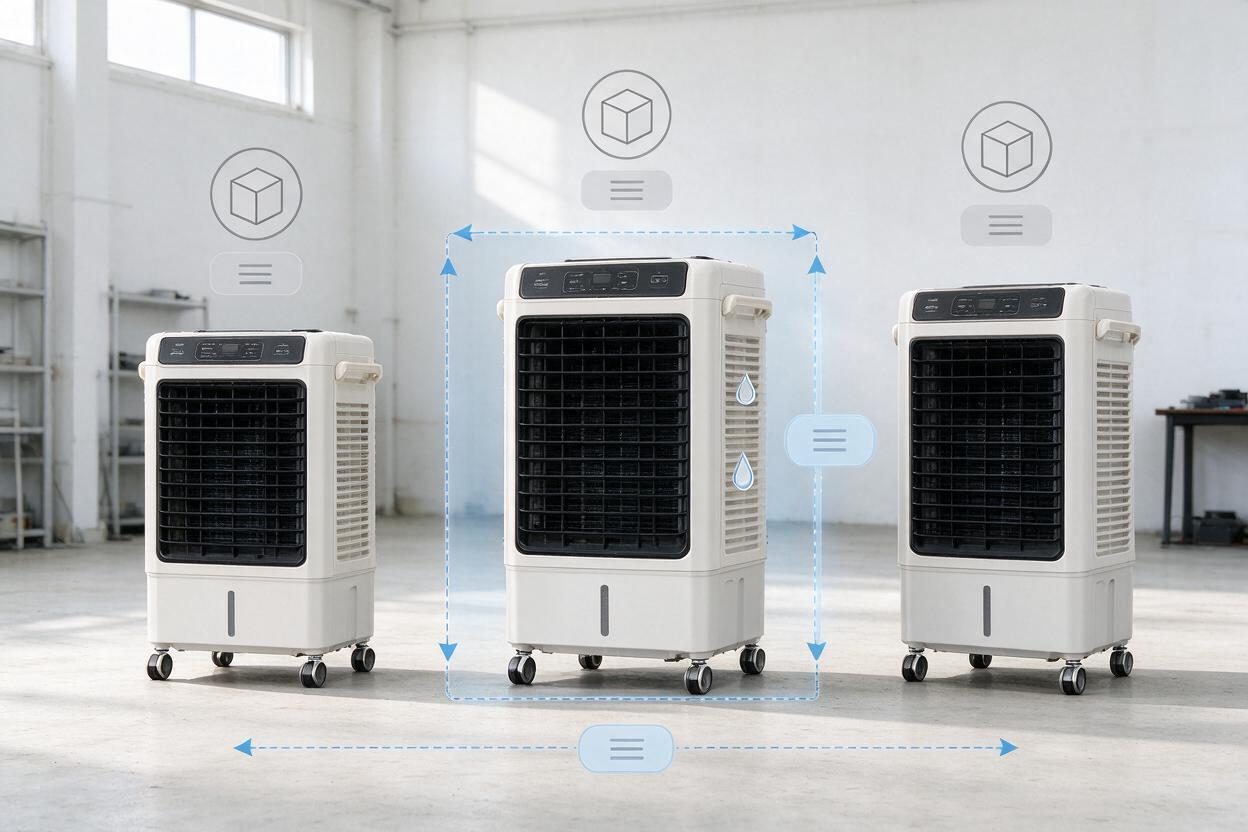
Most wrong cooler orders fail the same way: the buyer orders on one number — usually airflow or price — and discovers the installation facts afterwards. This guide puts the installation facts first, in the order you should check them.
Step 1: evaporative or refrigerant?
Start here, because it changes everything else. If the job is a zone or a hall with open doors and fresh air wanted, evaporative is the technology: the duct units on this site. If the job is one spot, a sealed room, or humidity-sensitive work, refrigerant is the technology: the DH-A spot coolers, clearly labelled as refrigerant units on this site. If you are unsure, describe the building to the supplier — open or sealed, humid or dry, zone or spot — and let the building decide, not the catalogue.
Step 2: airflow, honestly
Airflow is the headline number on every cooler page: 18000, 23000, 30000 cubic metres per hour for the duct series, 400 to 1200 for the spot series. What airflow does not tell you is coverage. No coverage area is stated on the product pages, and any supplier who converts airflow into square metres without your ceiling height, heat load, and exhaust route is guessing. Give the supplier the building — size, height, heat sources, openings — and ask for a layout, not a unit count from a table.
Step 3: water and drainage
Evaporative coolers drink water: 10 to 25 litres per hour on the duct units, from a 300-litre tank. That means a refill routine and a drainage plan, costed before ordering. Spot coolers carry only 6 or 11.5 litres, because they are not evaporating water for cooling — a useful reminder that the two families do not share running costs just because both are portable.
Step 4: voltage and control
Duct units come in 380-volt manual versions and 220-volt LCD versions with 12 speeds; spot coolers run on 220 volts at 50 hertz. Check the voltage at the exact place the unit will stand, not the voltage the building has somewhere. And decide whether you need multi-speed control or whether manual single-speed suits how the unit will actually be run — paying for 12 speeds nobody touches is waste, and needing variable speed you did not buy is a second order.
Step 5: duct, placement, exhaust
A duct unit needs three things placed right: intake air, the duct route to the zone, and an exhaust route for the air it pushes in. A spot cooler needs one thing placed right: the spot itself, with somewhere for its warm air to go if it is a ducted variant. Walk the route before ordering. Photograph it. Send it with your inquiry. The suppliers who ask for that walk are the ones whose quotes fit.
Niche cases, briefly
- Garage cooling: a small portable cooler or a duct unit aimed at the work bay, not the whole garage. Ventilation matters as much as temperature in a garage with fumes.
- Humid climates: evaporative cooling's temperature drop shrinks as humidity rises. In a humid climate, weigh a spot cooler for the occupied spot against evaporative cooling for the whole space.
- Battery or 12-volt use: the units on this site run on mains voltage (220 or 380 volts at 50 hertz). No battery or 12-volt version is listed, so do not assume off-grid operation.
Questions to ask before you pay
- What is the layout: which unit, where, with what duct route and what exhaust provision?
- What voltage and water supply does that exact position have?
- What is the MOQ, the lead time, and the warranty — none of which this site states, because none was verified?
- What does the quote leave out: exhaust, circulation, sealed-room cooling, water, drainage, controls?
Before ordering, confirm: the exact model and voltage for your site, the airflow and size you need, MOQ, lead time, and warranty. This page lists only what the source material verifies; anything not listed here is a question to ask, not a specification to assume.
Request a mobile cooling layout
Send your space size, heat source, and voltage, and ask for a layout using the equipment families on this page. Before payment, confirm MOQ, lead time, voltage, and warranty for your order.